Grace Kelly appears as Lisa Fremont 16 minutes into Rear Window. Sudden and dreamy. Her face—red lipstick and pearls—fills the frame as she leans forward into it and casts shadows over Jimmy Stewart’s sleepy LB Jefferies. It’s an image you’d struggle to make more beautiful, and then she stands.
At first, it’s just the top of her bodice: a black v-neck and the sheer white shawl. She moves slowly about the room, turning with each movement to reveal a little more, the camera following her and pulling slowly out. With each beat, she turns on a lamp, gradually lighting up more of the room and herself. ‘Reading from top to bottom,’ she says, ‘Lisa’—a glimpse of her sparkling black clutch and white satin gloves—‘Carol’, the black beading that runs from her waist down the outer and second layers of the white chiffon tulle skirt—‘Fremont’, the full dress in all its glory, cut above the ankle to display a pair of dainty crisscross strapped black shoes. At last she spins in the warm yellow light.
Edith Head: Hitchcock’s collaborator
Edith Head designed the costumes for 11 of Alfred Hitchcock’s films, a collaboration which spanned from Notorious in 1946 all the way to Family Plot in 1976. In this instance, ‘collaboration’ is an accurate word. Hitchcock was an active participant in this aspect of his films. He, a famous control freak, was well known for presenting his costume designers with strict instructions, particularly in regards to colour, even detailing his visions for dresses in the scripts themselves.
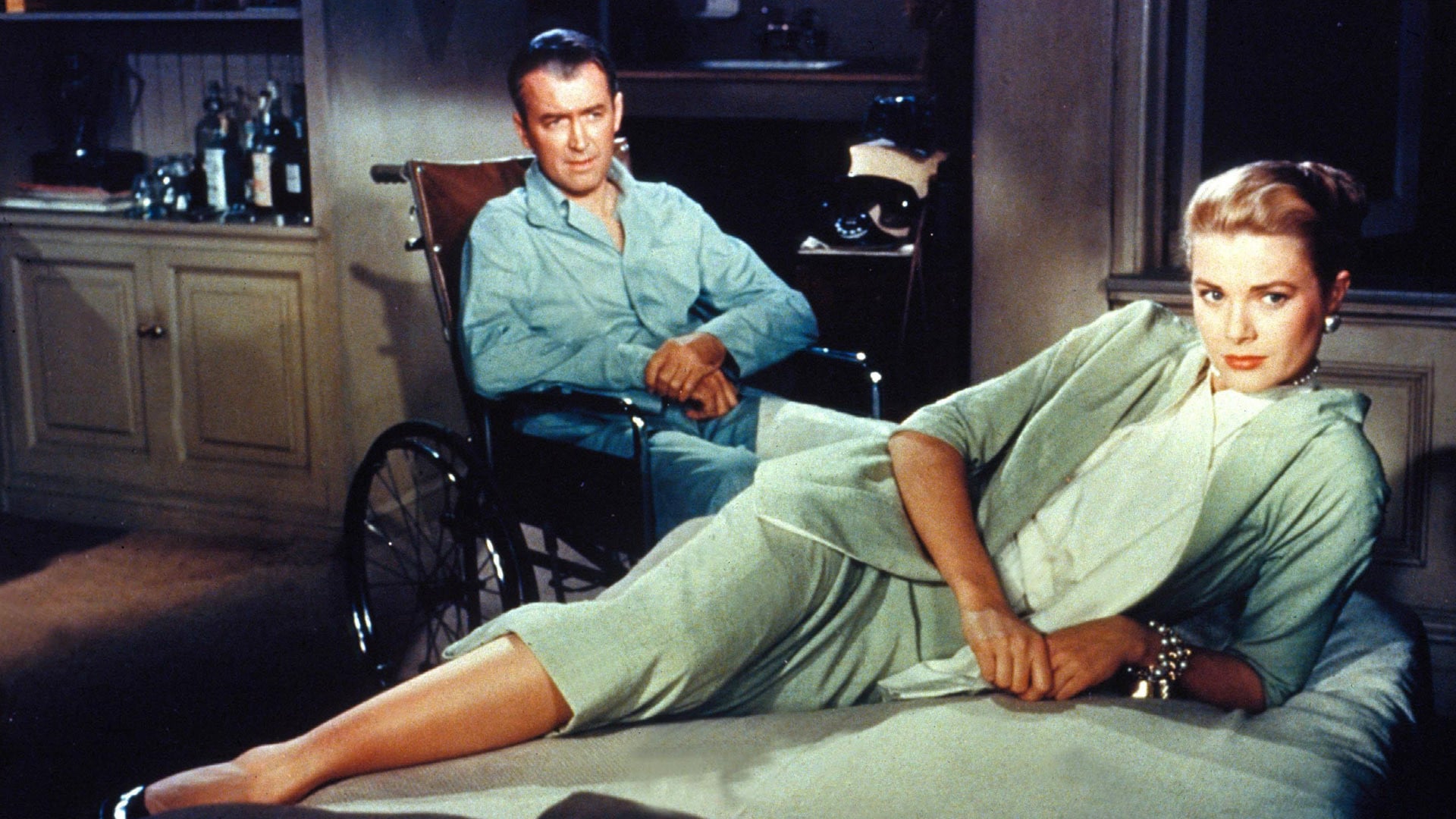
Grace Kelly’s dresses in Rear Window are far more glamorous than the film’s setting, to the extent that they seem sort of ridiculous in the context—and deliberately so. Especially next to Jimmy Stewart, who spends the entire film in a selection of (admittedly rather nice) pyjamas, cut off at the leg to fit his enormous cast. The film isn’t set at parties or in ballrooms or elegant dinners, unlike 1955’s To Catch A Thief—the following Hitchcock/Head/Kelly collaboration—where opulent hotels on the French Riviera make the glamour of Head’s designs feel quite at home.
Edith head’s costume designs for Rear Window
Rear Window is set in one room of a New York apartment in the height of summer, brought to us in saturated Technicolor, and with a crowded city soundscape from wide-open windows. Here, Lisa’s dresses take up so much of the frame, highlighting just how out of place they (and she) are.
At times, Lisa’s job in fashion seems less a character detail illustrated by costume than an addition made to justify costume. This is not to say, however, that Head’s designs do not serve a narrative function. Lisa shows no insecurity in being overdressed, only delight at the opportunity to show off. “A steal at eleven hundred dollars,” she teases, introducing the first dress. Her elegance charms us, but it frightens LB Jefferies. We watch him, helplessly overwhelmed by the vision before him, and her, perhaps pleasantly oblivious, perhaps well aware it will work soon enough. Costume in Rear Window serves a comedic function as well as existing for visual pleasure—though sheer spectacle would hardly be out of place in a film about voyeurism.
Head’s designs don’t just exist within the film, they form a part of it. Lisa and her first dress are introduced in tandem. It sets the tone for the five outfits yet to come. Kelly’s second dress is only slightly less ornate than the first. The New Look style is a repeated silhouette throughout the film; cinched at the waist and a full skirt, this time in all black. The bodice is built of a sweetheart neckline and an overlaying sheer black fabric, which crisscrosses the neckline into short sleeves. Completed by a narrow black belt and three rows of pearls (yes, a different set of pearls than those seen with the first dress).
With this dress, we are treated to Kelly sitting in the window seat (a perch that serves costumes well throughout the film), smoking in that elegant way only movie stars can. Her skirts are splayed out and the dress is shot from down by her feet, as LB Jefferies speculates on the logistics of chopping up a dead body.
Hitchcock knew how to film costumes, and Kelly knew how to wear them.
Clothing as characterisation
The third outfit is a pistachio green suit—an early (though perhaps less recognised) version of Tippi Hedren’s in The Birds—this, also designed by Head, forms a large part of the film’s visual memory for many Hitchcock fans. The fabric of Kelly’s hangs more lightly than Hedren’s—partnered with a white halter-neck blouse, belt and pillbox hat. Each outfit in Rear Window is carefully shown in all its forms. With and without the hat, the jacket, shawl, gloves… Throughout, we see Kelly not just wearing, but interacting with clothing. The care with which she takes off a hat or satin gloves, the pride with which she poses in a new piece.
Clothes don’t just make Lisa Fremont beautiful, they matter to her. As far as plot goes, Lisa offers a feminine perspective on the mystery—an early version of Scooby Doo’s Daphne Blake role. It is she who notes (with some horror) the unlikeliness of a woman leaving behind a favourite handbag and jewellery when going away on a ‘trip’.
The fourth look: a silk satin nightgown, slippers and cape, are teased for much longer than they are worn. Lisa playfully unpacks them from a tiny mirrored night case, much to the horror of their abrupt visitor, Detective Doyle. (In 1954, this was about as far as the Hays Code—a morality code that dictated what could and could not be included in Hollywood films—could be pushed). When she precedes her costume change with the words “preview of coming attractions” and swishes the open vanity case in front of LB Jeffries’ eyes, it’s as though she’s speaking to us as well as him.
The reveal itself is so ridiculous and so gorgeous we don’t know whether to laugh or swoon. A nightgown more glamorous, more sophisticated than most women’s best dresses. The back, for me, is a particular highlight, shown briefly as Lisa runs to the window to see the source of a distressed scream. Two loosely pleated pieces of silk, pinched at the waistband in a deep V.
Grace Kelly: Making casual chic
Kelly’s fifth costume is a return to the New Look, this time in a season-appropriate floral and red-brown heels. Her reliable combination of pearls and red lipstick (perhaps we should all take notes) is present even in this daytime look. In this dress she runs around and clambers over fences. She even climbs a fire escape into a second story window. She’s now completely involved in the intrigue, and no less elegant for it. Grace Kelly moves as though she spent much of her childhood balancing books on top of her head—no wonder she became a princess!
The final look is shown only for the briefest epilogue. The moving camera (after an amusing reveal of LB Jefferies’ now double leg casts) shows us, in order, a pair of brown loafers, rolled-up blue jeans and a coral red shirt. It, bizarrely, has always been my favourite. In theory, it’s casual. Somehow though, the ensemble feels just as exquisite as all the gowns that came before it, and as she sneakily lifts Bazaar’s beauty issue into the frame, I’m comforted that after all this, Lisa hasn’t really changed. Perhaps the simple elegance of these jeans comes from Hitchcock’s graceful camera movement, perhaps from Edith Head’s skillful selection, or perhaps because they are worn by Grace Kelly. No one has ever suited the name ‘Grace’ more.
Rear Window is showing at Pictureville on Saturday 14 March 2026 as part of our Four Seasons of Hitchcock event. Find out more and book tickets on our website.