H R Giger is recognised as one of the world’s foremost artists working in the fantastic realism style, and his grotesque, surreal and terrifying art changed the landscape of sci-fi and horror forever. While his influence can be seen in countless films, album covers and video games, his most iconic work remains the biomechanical creature from Ridley Scott’s 1979 masterpiece, Alien. The Xenomorph wasn’t just another monster in a rubber suit; it was a disturbing and unforgettable work of art that embodied the darkest fears of its creator. This is the story of how Giger’s nightmares became the perfect killing machine.
Developing a biomechanical style
Born in 1940 in Chur, Switzerland, from a young age Giger developed a strong passion for all things surreal and macabre. This, along with his strong imagination and need to express himself, naturally led him to consider visual arts as a profession. His father, a pharmacist, viewed art as a ‘breadless profession’ and strongly encouraged his son to pursue a career in pharmacy.
In 1962, Giger moved to Zurich to study architecture and industrial design and began producing his first ink and oil paintings in 1964. This resulted in his first solo exhibition, swiftly followed by the publication and distribution of his first poster series. Shortly after, Giger discovered the airbrush, and along with it, his unique freehand painting style for which he is recognised today.
This biomechanical art style is synonymous with Giger’s work, but what exactly is it? In short, it is a surrealist style of art that combines mechanical and organic materials and renders them with a distinct realism, resulting in hybrid forms that often depict something other-worldly, dreamlike or futuristic. This strange aesthetic goes beyond the fantastical into something that is both magical and unsettling in equal measure. It is these elements that are central both to Giger’s work as a whole and the creation of the most iconic sci-fi horror monster.
The influence of surrealism
Surrealism is more than just a style, it’s a rebellion. Surrealist artists believed that our everyday, rational view of the world was incomplete. They wanted to tap into something deeper and more powerful: the unconscious mind and our dreams. André Breton, the movement’s leader, famously defined it as ‘pure psychic automatism’, which basically means letting your mind wander without any logic or rules getting in the way.
Within the surrealist movement there was something of a ‘style war’, with artists like Salvador Dalí and René Magritte painting their dream worlds with photorealistic detail with the aim of making the impossible look completely and disturbingly real. Other artists like Joan Miró and Yves Tanguy took the opposite approach, using abstract blob-like forms that looked like bizarre, imaginary organisms, reflecting the fluid nature of the subconscious.
Giger is often linked to Dali’s hyper-realistic style, and it is well documented that he was a huge fan of his work. However, looking closer at Giger’s work reveals that he was actually fusing both of those surrealist styles to create something new. Using incredibly precise air brush techniques to depict his grotesque organic shapes, he perfectly combined Dali’s meticulous skill and Miro’s non-geometric forms.
Exorcising nightmares through art
Giger’s artwork was deeply rooted in his personal life. He suffered from chronic night terrors and would use his art as a form of therapy to “exorcise the visions” that haunted his nightmares. He would even keep a sketchbook by the side of his bed to quickly capture the “demons” that visited him. This need to turn his fears into something tangible is exactly what the surrealists were about. Giger described his creative process in a way that also sounds similar to the surrealist idea of automatism, stating that when he started a painting he had “no idea what I was doing” and that the images “came from the belly”. It was a spontaneous outpouring of his subconscious mind.
While the original surrealists explored the subconscious world of dreams, Giger was all about nightmares. He felt that the subconscious had a ‘dark heart’ full of primal fears that most people would never confront. His art was a journey into that darkness, applying surrealist methods to reveal a visceral horror that commented on the fears of the modern world.
By 1977, Giger’s work was gaining traction around the world. That year he published Necronomicon, a book showcasing a selection of artworks that would go on to sell thousands of copies and be printed in multiple languages, and it’s within these pages that the origin of the Xenomorph lies.
In 1979, during the early stages of production for Alien, the film’s director Ridley Scott was given a copy of Necronomicon by the screenwriter Dan O’ Bannon. O’Bannon has become familiar with Giger’s work whilst working on an ill-fated Dune project and recalled: “I had never seen anything that was quite as horrible and at the same time as beautiful as his work” – a statement that perfectly sums up a Xenomorph.
A terrifying design
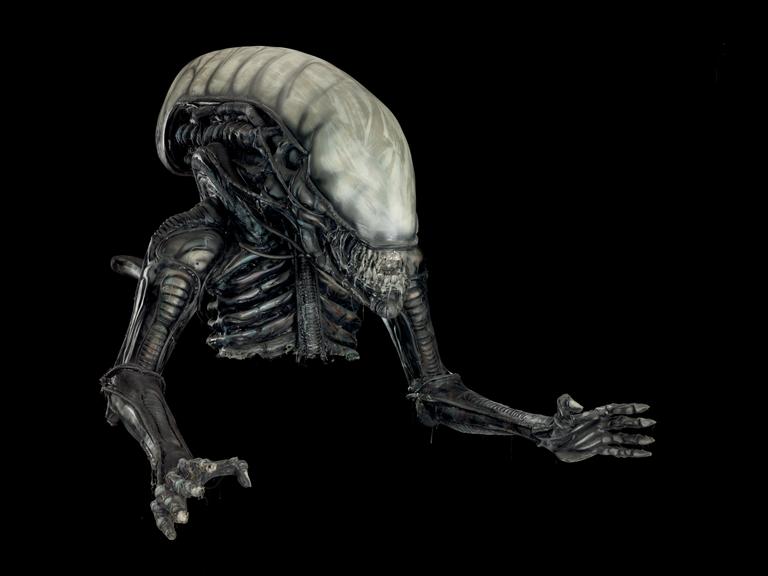
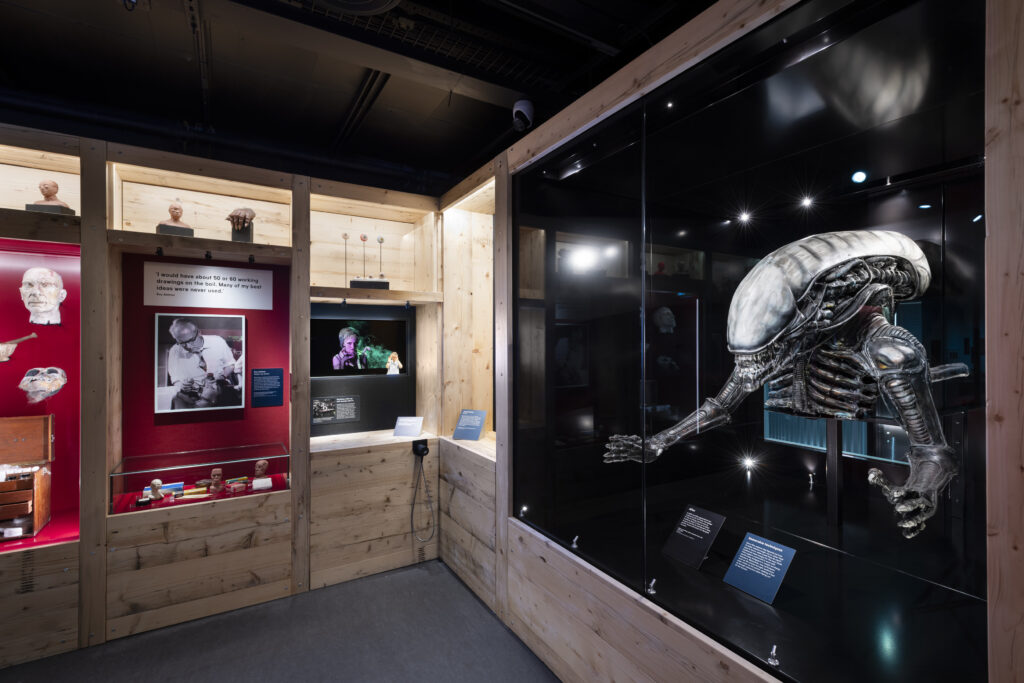
Scott immediately saw the potential in Giger’s artwork and the chance to create something truly unique. He chose Necronom IV, a painting Giger had completed in 1976, as the basis for the alien’s design. Looking at this artwork, the similarities with the eventual creature design are clear. The elongated head, the graceful armour-covered body and snarling mouth. However, there is one key difference: this creature had eyes.
Fox were initially wary of allowing Giger onto the project, claiming that his work would be too disturbing for audiences, but eventually they relented. Giger offered to design the alien from scratch, but Scott mandated that he base his work on Necronom IV, saying that to start over would be too time-consuming. Giger signed on to design the adult, egg and chest burster forms, but ultimately designed the alien planet LV-426 and the space jockey vessel too.
Giger conceived of the alien being vaguely human in form, albeit a human covered in armor and protected from all outside forces. He removed the creature’s eyes as he felt it made the creature much more frightening if you could not tell if it was looking at you. A secondary change was the addition of the second inner set of jaws within the alien’s mouth, located at the end of a tongue-like appendage, which quickly extends to be used as a weapon.
The lack of eyes on the creature completely removes that familiar feeling we have when we come face to face with monsters. We can’t read the creature, making it much harder to understand its intentions. Pair this with its sheer strength, the camouflage of its dark body among the shadows of the ship, the imposing size and freakish ability to move so quietly despite that, and you instantly have the recipe for a truly unnerving creature that you certainly don’t want chasing you down on a stranded spacecraft. It perfectly embodies the apex predator toying with its prey, only giving itself away with excessive salivating when close to its victims. And let’s not forget that when you hurt it, its blood is acidic. Now that hardly seems fair. The design makes the creature hard to understand biologically, again taking us one step further away from any creature we might be familiar with. There’s something, well, alien about it.
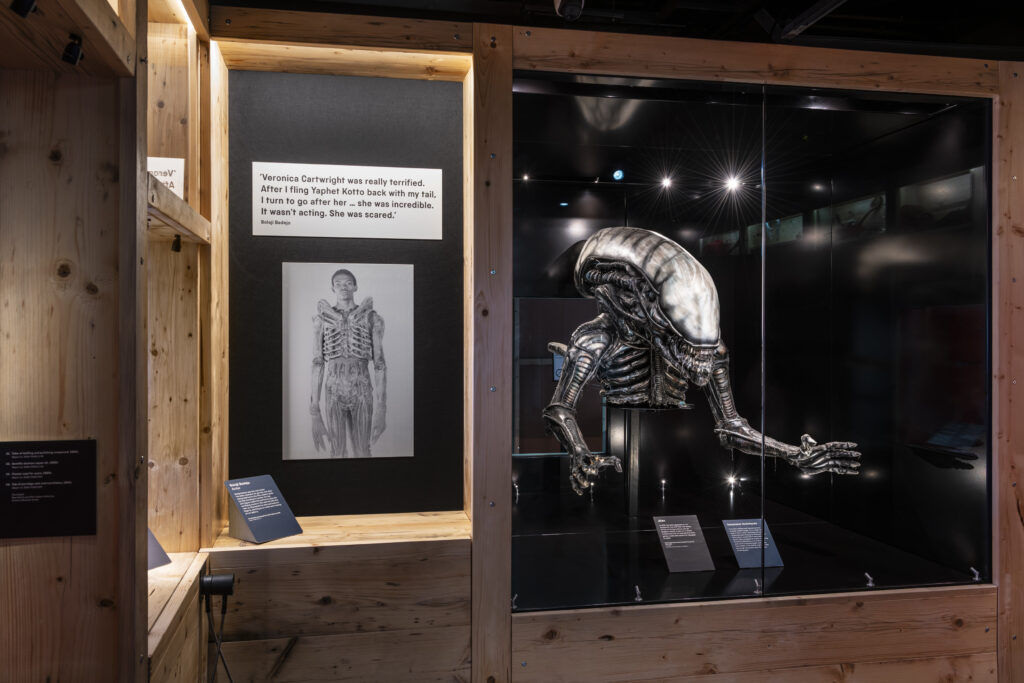
It’s clear that the alien’s design stays true to Giger’s core philosophies and aesthetics, perfectly encompassing the biomechanical style. But while it is easy to focus on the terrifying nature of the xenomorph’s design, credit must be given to the earlier stages of its lifecycle. A great example of this is the ‘face hugger’ which encapsulated that claustrophobic and violating feeling that the film creates.
The face hugger was actually the first element that Giger designed for the film. O’Bannon had sent Giger about $1000, along with some descriptions and rough drawings explaining the concept of the film, and stated that the creature Giger made would be jumping out of an egg. Horrifyingly, Giger’s original concept for the face hugger was much bigger, with eyes and a coiled, spring-like tail to help it jump onto its prey. After feedback he made it smaller and more similar to a human hand as he felt it would be scarier-again playing with the surrealist idea of the uncanny (something being familiar but not quite) with its long, spider-like fingers that allow it to grab onto its victim’s head.
So there you have it: H R Giger’s designs for Alien weren’t just good, they were transformative, bleeding through the screen into our subconscious and forever changing what we expect from cinematic horror. The Xenomorph isn’t just a monster; it’s a living nightmare sculpted from the fears of its creator. A fever dream of surrealist art that was brought to life. His work elevated Alien from a simple sci-fi creature feature into a true masterpiece of atmospheric horror. As Dallas famously says: “I’ve seen some goddamn strange things in my time, but this…this is a new one”.