It’s always exciting hearing the Brontës being mentioned or brought up in conversation in interviews or articles, so with a new adaptation of Emily Brontë’s Wuthering Heights with a strong marketing campaign behind it, Brontë fans are seeing Emily plastered everywhere on social media, TV and billboards across the globe.
As always with well-loved books, an adaptation often divides opinion. When Wuthering Heights was originally published, it certainly did just that and continues to divide opinion to this day. This could be because readers go in expecting the sweeping romance that its reputation has led them to believe it is, but are shocked by the violence and hate woven into the narrative. The first adaptation was filmed on location in Haworth, the home of the Brontë sisters. Sadly, this film is now lost, but we live in hope that it may be found in a forgotten corner of a film archive. Since then, there have been countless adaptations for stage, film, television and of course music, and there will be countless more to come.
The themes of the Brontës’ works are timeless and continue to relate to different generations in new ways. William Wyler’s Wuthering Heights was filmed in Burbank, California in 1939. It’s the adaptation which could be seen as the movie that gave Wuthering Heights it’s romantic reputation. While Laurence Olivier was filming scenes calling “Cathy, come home” in a studio-made snowstorm, Hitler spewed threats of World War Two. A story of love that transcends time would perhaps have been more fitting for the world at this time, than a story of hate and revenge.
The 1970 film directed by Robert Fuest, starring a pre-Bond Timothy Dalton and Anna Calder-Marshall, and Peter Kosminksy’s 1992 adaptation, which features Sinéad O’Connor as Emily Brontë, both kept closer to the novel’s setting. While they were filmed in Yorkshire with historically accurate costuming, other versions have completely stepped away from the setting and time period of the novel.
Luis Buñuel set out to create his vision of Wuthering Heights in the early 1930s, but it wasn’t until 20 years later he would finally get the project off the ground with Abismos de pasión in 1954. Buñuel’s film starts the story with Alejandro (Heathcliff) returning a wealthy man and gatecrashing Edgar Linton’s happily ever after with Catalina (Catherine). The film sets Wuthering Heights in a gothic hacienda in rural Mexico.
Bollywood produced Dil Diya Dard Liya in 1966, filmed on location in the historic ruined city of Mandu. This colourful, dramatic and romantic adaptation takes inspiration from the quote Nelly Dean gives when she exclaims to Heathcliff “You’re fit for a prince in disguise. Who knows but your father was Emperor of China, and your mother an Indian queen”—the viewer is shown at the start of the film that Heathcliff is in fact a prince, who was believed to be lost in a shipwreck. The film also features songs performed by Dilip Kumar as Shankar (Heathcliff) and Waheeda Rehman as Roopa (Catherine), although with a runtime of nearly three hours, you’ll want to buy some extra popcorn!
In 1988, Yoshishige Yoshida transported Wuthering Heights to medieval Japan, and portrayed Heathcliff as a violent samurai living in a bleak, eerie wasteland. This beautifully shot film certainly leans into the violent side of Emily’s novel.
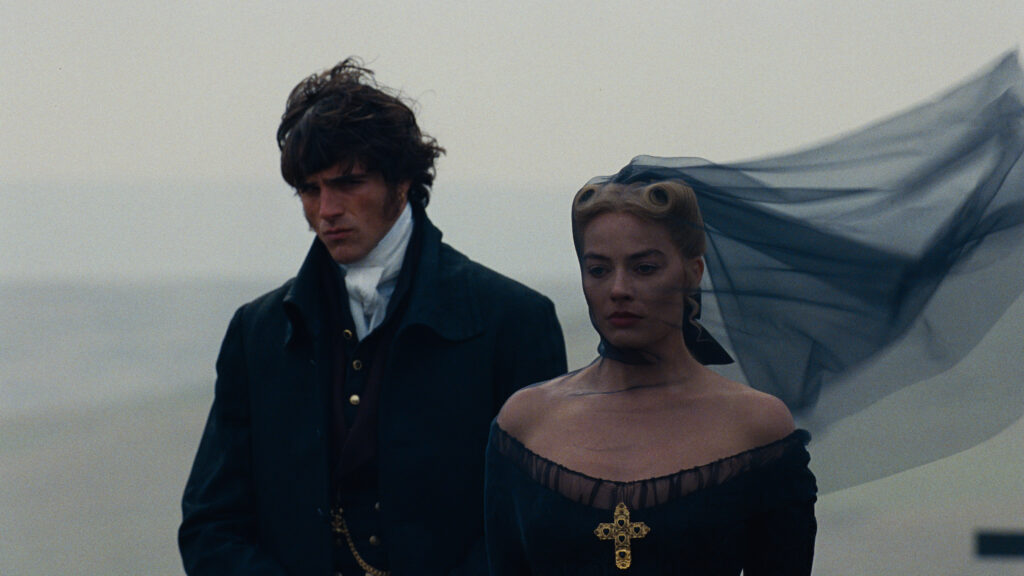
Emerald Fennell explained that she placed quotation marks around the film’s title because this is her personal vision of the story, and that really, all adaptations should be viewed as such. It would be interesting to know what Emily would make of it all, her book once again ruffling feathers and dividing opinion as it did almost 180 years ago.
Wuthering Heights screens 13–19, 20–22, 24–26 February across Pictureville’s three immersive auditoriums, including IMAX.