Having written about animal photography in the Daily Herald archive, I was excited to interview Stephen, who first started working for the Daily Herald when he was just 19. At the time he was the youngest photographer on the staff of any Fleet Street daily paper.
Hannah: How old were you when you first started working at the Daily Herald and how did you get the job?
Stephen: I think I had just turned nineteen. I was working for the Burney News Agency in Wakefield, Yorkshire. We worked for all the national daily newspapers and were commissioned by their regional office in Manchester. Film was sent on the train and collected by a motor cycle messenger. It was normal for me to ring a picture desk (in Manchester) to tell them the arrival time of the train.
I had just completed an assignment for the Daily Herald and put my film on a train to Manchester. I rang the picture desk with the train time and the Picture Editor, Ron Graham, answered the phone.
’Stephen, he said, ‘nice to speak to you. I have to say how much I like your work… If ever you are in Manchester I would love to meet you.’
I was really flattered and excited by what he said, naturally. With the impetuosity of youth, I took the next day off and just happened to be in Manchester! With the excuse that it was just a coincidence, I met Graham. He was very complimentary and we chatted for about half an hour before he then said ‘how would you like to be one of my staff photographers?’
I cannot believe to this day what I said. I thanked him and turned him down! The look on his face I will never forget!
‘Why on earth not?’, he asked incredulously. ‘Because I want to work in London’, I told him.
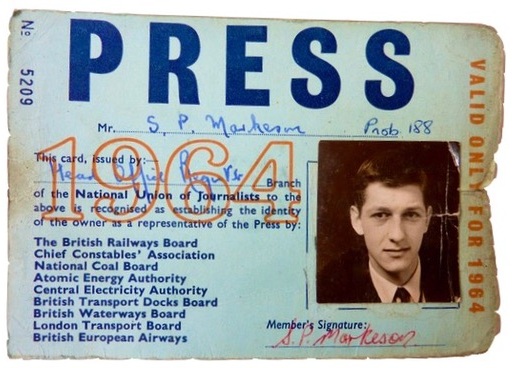
He offered to send a letter of recommendation to the Picture Editor in London, Len Hickman. A week later I had a call from Hickman to come for an interview in London. He offered me a job which was fantastic, but it almost ended in tears. In those days, membership of a trade union was mandatory. Of course it was especially important as the paper was controlled by the Labour Party and the unions were very powerful.
21 was the minimum age for membership of the National Union of Journalists and I was just 19 and they refused [my] membership. The management were so keen to have me work for them that the editor got involved. The Central London branch called an emergency meeting and it was agreed to allow me membership.
I was then the youngest photographer on the staff of any Fleet Street daily paper.
Hannah: Why did you want to be a photographer?
Stephen: My father wanted me to be an architect which didn’t appeal at all. I went to the London School of Printing and Graphic Arts as I thought photography would allow me freedom of expression. Whilst at that college I took an additional course in the history of printing which included studying the ancient Egyptian Hieroglyphics on the Rosetta Stone. In the final exam which included translating the hieroglyphics I got the highest score any student had ever achieved – 99% (one mark deducted for bad hand-writing!)
The principal was very excited and told me he had contacted Oxford and Cambridge who both wanted me. I was terrified – I didn’t know anyone who ever went to university and anyway I wanted to be a photographer. Much to all the academics’ disappointment I turned the offers down so my career could’ve taken a very different course.
My first camera was a Rolleiflex but I also had a Nikon 35mm camera which I used alongside my Leica M2.
Hannah: What did your day to day work look like?
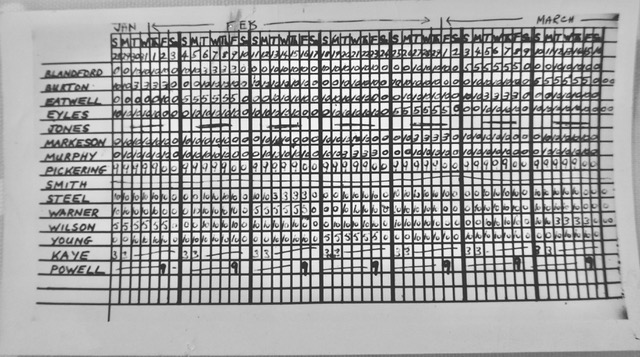
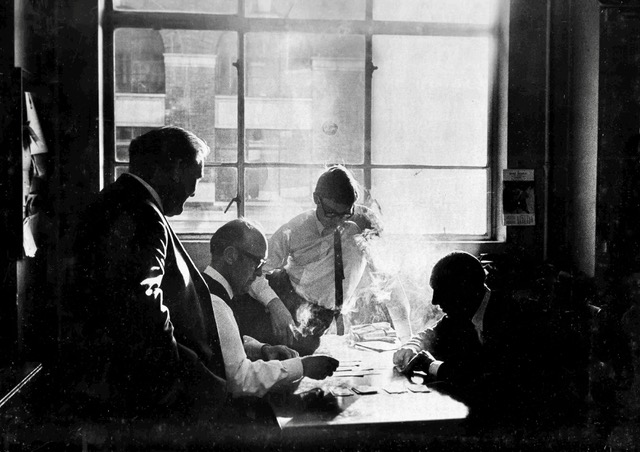
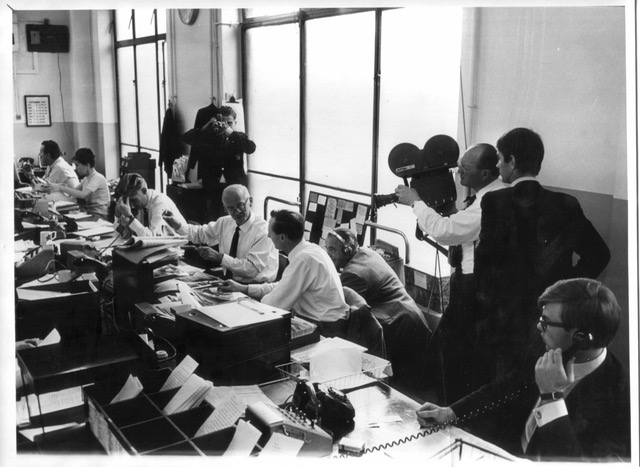
Stephen: Every day was different. We never knew what to expect. Maybe a ‘doorstep’ job on an investigative story or a court case at the High Court or the Old Bailey. Mods and rockers riots at Clacton-on-Sea or civil unrest in London. Lots of political stories of course including coverage of the Labour Party conference. [There was also a] plane crash disaster which was very disturbing. Football, horse racing (the Derby and Grand National) and Wimbledon tennis. We would wait in the photographers room smoking and playing poker whilst waiting for an assignment.
[There was a] complete spectrum which made it very exciting including The Great Train Robbery [and] the Auschwitz war crimes trials. [It’s] difficult [to say what my most memorable assignment was] as there were so many, but covering the Auschwitz war crimes trials was my first assignment abroad and very harrowing.
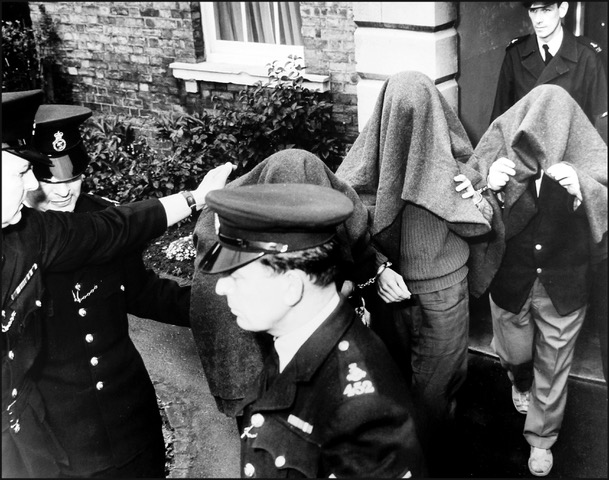
[I’m also proud of my photo of] Ronnie Biggs and his cohorts handcuffed, leaving a police station after the Great Train Robbery.
Hannah: How did you feel when the Daily Herald closed?
Stephen: It was a very sad day. The paper had some fabulous photographers during its life. It respected photographers and used photographs well. It was also the mouthpiece of the Labour Party and it’s never been replaced [to] this day. [The Daily Herald] should be remembered not just for its understanding of the importance of photography to illustrate stories but for its campaigning and respect of the working man. All employees felt valued and it was easy to make yourself heard as the editors door was ‘always open’ and the National Union of Journalists’ Father of Chapel was a great presence as well.
Fantastic article Hannah, thank you for sharing
Do you still have a contact route to Stephen Markeson? …email perchance