Chloe Zhao’s Hamnet makes many more direct references to Shakespeare’s work than Maggie O’Farrell’s original novel. Film, as a form, is perhaps more bound to this cultural expectation than prose. The first explicit instance is a young Shakespeare stood quietly in front of his desk, whispering words we all know to himself. But soft, what light through yonder window breaks? It is the East, and Juliet is the sun… As he speaks, he taps the beats lightly against his chest. Measuring the meter like music. I think we have a tendency, with Shakespeare, to imagine that his immortal words were just within him. That they sprang, in fully formed iambic pentameter, directly to the page. To see him like this, counting in the candlelight, in the depths of night, crouching quickly to transcribe the words before they escape him, is to remind ourselves how impossible that is. Shakespeare, like any writer, agonised over his work, over every word and every beat. At times it will have been euphoric and at others it will have been tortuous. Of course it was. He was human.
Four hundred years is a long time. Long enough ago to feel like fiction. We read about the plague in its numbers and gory details. Bodies piled up and carted off. Red Xs on doors. It’s rare, I feel, to see a story that shows us the plague’s horrors on such a personal level. We don’t know how the real Hamnet died, but given the era, O’Farrell’s invention is hardly a stretch. When the plague takes him, we are given a tragic twist on Twelfth Night in which young Hamnet believes he is deceiving Death by lying in his twin sister’s place. In O’Farrell’s novel, this moment is narrated by Hamnet himself, and he remembers all the times they tricked their parents by swapping clothes, when they’d be called by one another’s names. The film puts the novel’s events in chronological order, meaning we watch one such moment play out, and it’s moments like this that Zhao’s film acts as such a wonderful companion to the novel. In the film world we need much more convincing than in prose or theatre, we can’t believe these two faces are truly muddled up. Instead, it’s a sequence of two parents in perfect synchronicity, in wordless agreement, playing along with their children’s trick. Out of love and charm. For lovers of the novel, Hamnet’s youthful belief in deceiving Death will forever be still more tragic.
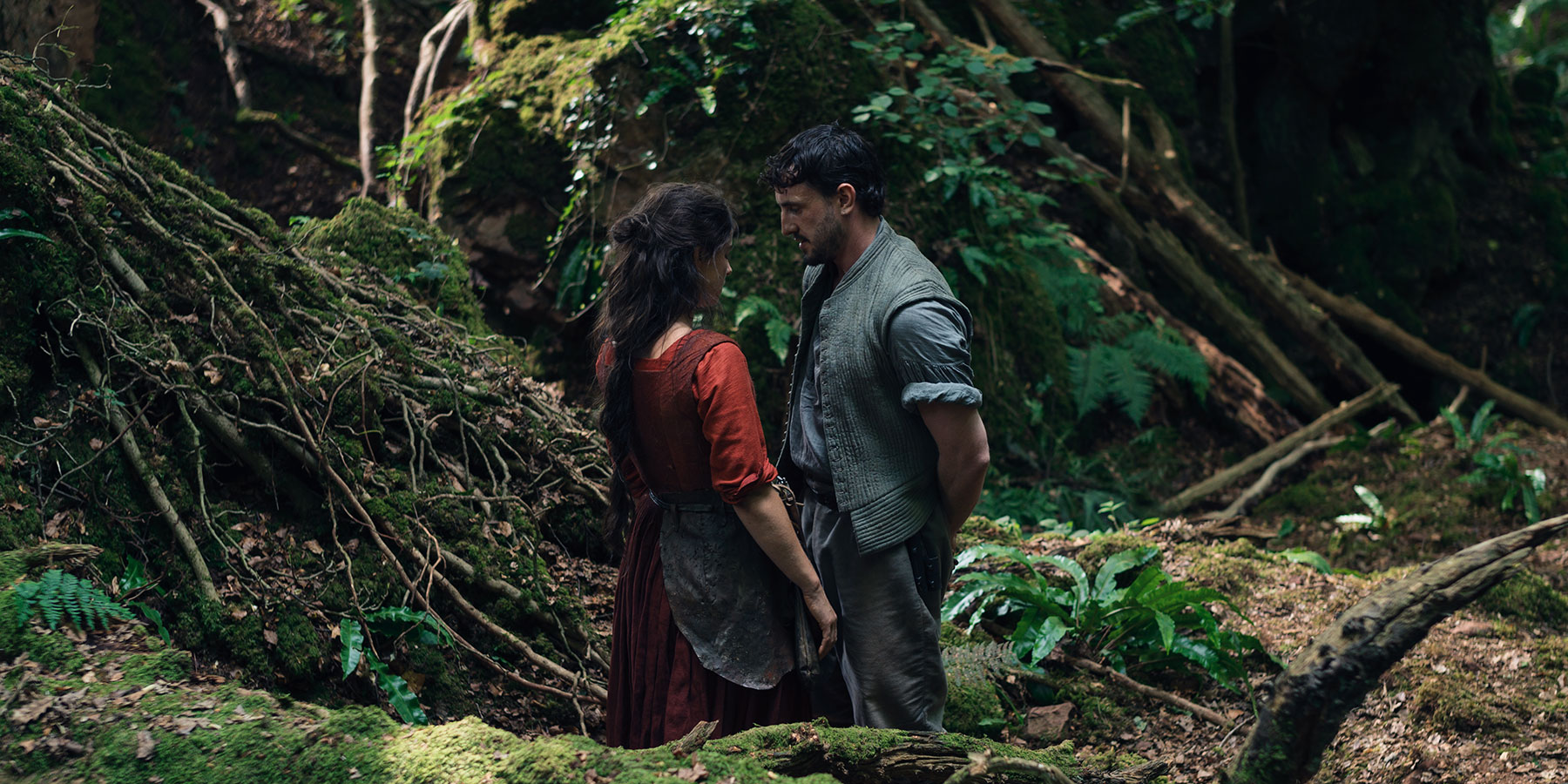
What translates perfectly from words to image is this story’s deep and binding connection to the land. Agnes is a part of her landscape. The earthy and twisting forest, her hawk and her herbs. Hamnet too, with his blue eyes and sandy hair and gentle nature, looks quite a part of the crops and the hay. There is a conflict at the side of this, which Zhao handles deftly. Where Agnes and her children are tied to their home, for Will the countryside is confining. For him, vastness and the real extent of the world are only to be found in the cramped city streets. It’s not played as ill-fated, just a thing to navigate.
When the family are faced with the potential loss of Judith (only to later confront the real death of Hamnet) the dread of it is tangible. Mary (Agnes’s mother-in-law) speaks of what it is to lose a child, from her own experience of losing three. It’s acutely apparent that the prevalence of child mortality has no softening effect on its impact. People in the 1500s didn’t love their children any less for the risk of losing them. In the book, Mary’s simple narration on the near certainty of losing Judith (her granddaughter) is harrowing: “we won’t get to have her anymore”. Yes, children in their time died all the time. But what comfort was that? Hamnet’s death happens in horrible screams of pain, in convulsions and cries, but it ends in a much worse silence. An absence. An absence that touches everyone. His mother, father, sisters, and grandmother. Later, we see that it has touched Agnes’s brother, Bartholomew, and somehow, in 1601 and through Shakespeare’s words, it has reached a crowd full of people who never knew Hamnet. But perhaps they know loss.
The film and novel’s premise relies heavily on the audience knowing that its tie to reality is fairly tenuous, given how little we really know about the family. The entire premise, in fact, is centred around a ‘what if’ thought that occurred to O’Farrell when she considered that despite writing during the height of it, none of Shakespeare’s work makes any explicit reference to the plague. Ironically though, the emotional heart of it comes in reminding us that these people were real. It strips back the mythology and shows them as people. A story that reaches right through time and makes us feel a deep and real grief and sorrow for a family that has been dead for centuries. It has people weeping in the masses: two women at my screening held one another through the credits as they sobbed. Because in 1596, a little boy died. And his mother’s scream echoes through the centuries.
Hamnet is showing at Pictureville until 22 January 2026. Find out more and book tickets on our website.
This is beautifully written and so well expresses some of my own feelings about both the film and the book which I loved. Really interesting point about 12th night, that’s such a tragic part in both the film and the book.