The plot of My Father’s Shadow appears straightforward. Two young brothers go along with their father to the big city. Father takes them to see some sights, then unsuccessfully attempts to pick up a long overdue paycheck. While they wait at a bar for the manager to return, the election results are publicly annulled, and martial law rapidly descends upon the city. A tale of two boys straining, in a new context, to connect with their semi-estranged father.
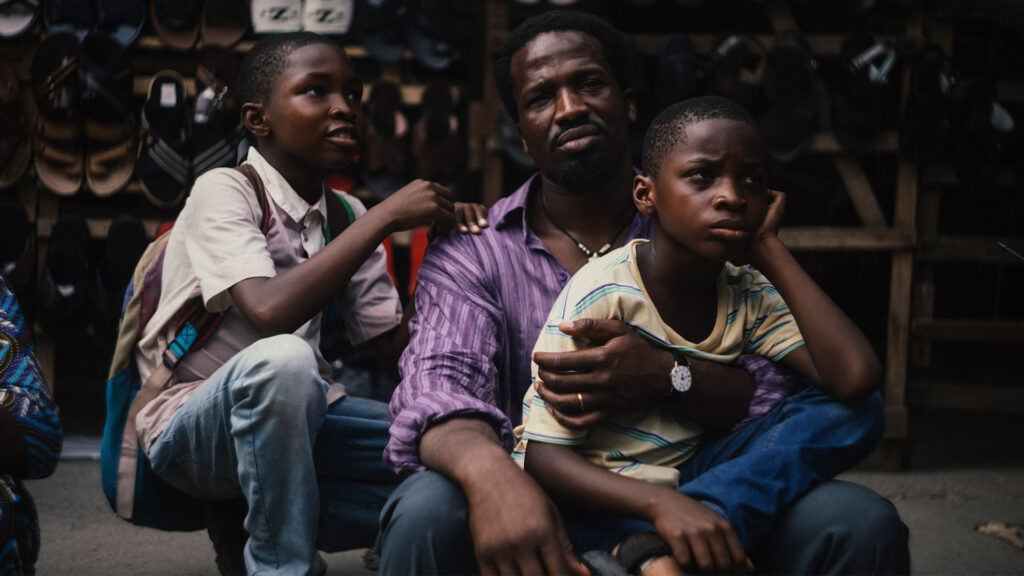
Yet what makes Akinola Davies Jr.’s feature film debut riveting is not what happens on the surface, but the steadily deepening world underneath. It’s in the rumbling, brooding sounds that haunt the film, even during moments of apparent lightness and joy. It’s in the layered texture of color: rich, bright shots flashing past as the camera zooms smoothly in on birds, buildings, streetside pots of boiling oil, and faces—always faces—then flicks onto its next passing subject. It’s in the unwillingness to flatten any character or image into a single representation. All of which brings 1993 Lagos, set against the backdrop of simmering political tension, vividly to life.
What is the primary responsibility of a man, of a father? How does one provide for one’s family? Is it more important to win bread or to be present during life’s ups and downs? These are the complex questions Folarin (Ṣọpẹ́ Dìrísù), known by his friends on the streets of Lagos as Kapo, struggles to answer.
Aki (Godwin Chiemerie Egbo), the younger of the two brothers, resents his father’s absence. Remi (Chibuike Marvellous Egbo), the elder, yearns for his attention and love. This is an age-old story retold with a powerful sense of place. The film subtly portrays the world through the boys’ eyes, holding consciously on their faces before flipping the camera’s gaze onto the bustling life all around them. Davies Jr. expertly layers archival footage of the actual protests and violence of early 1990s Nigeria onto the film, starting with infrequent early shots before regularly weaving them in as political tensions bubble to the surface, eventually bursting.
This broader context is slyly offered in fleeting bits and pieces: quick shots of newspaper headlines, overheard radio commentary, snatches of conversation in public. Everyone has an opinion they want to share—on a bus, in a restaurant, on the street. Persistent is an undertone of hope, a belief that the forthcoming election results, what many consider to be a foregone conclusion, will at last bring about much desired change. “The country is going to change,” a woman is overheard saying. And she believes it.
As the boys leave the usual confines of their village and enter the foreignness of the capital city, we watch their father become ‘Kapo’ on their awe-struck faces. Through a sequence of run-ins with connections who embrace him warmly and affectionately in Pidgin and Yoruba, which the boys don’t seem to speak, the mystery of their father begins to unravel. He is a man of the people, a respected figure who can be relied upon in this external world far away from the rural village life the boys exist within.
In the emotional crux of the film, father and elder son open up to one another on the beach. Father tells Remi that he named him after his drowned brother when, just before Remi was about to be born, a mystic stranger told him he needed to honor his dead brother and preserve his memory. Father admits, through barely held back tears, that he is missing the boys grow, that he’s unsure if he’s doing the right thing being away from them. He’s regretful, repentant; we feel his longing, believe he’s ready to change.
Soon after, seen directly through Remi’s eyes, we discover him whispering furtively with his beautiful mistress. An entire portion of his life remains inaccessible, relegated to the big city’s shadows. Then the election news drops and the world erupts around them. Nothing is as it seems; everyone is vulnerable.
My Father’s Shadow is a film about a single family as well as an entire nation. It is about love and what we do for those we love. It is a portrait and a moving image, an encapsulation of a specific time in a specific place, as well as a timeless rendition of how impossibly large a father becomes in the eyes of his sons.
My Father’s Shadow, a stunningly realized debut, achieves what few works of art can, what all are striving for—a sense of authenticity, of truth.
Catch My Father’s Shadow at Pictureville Cinema until 5 March 2026.