Georgia Oakley’s brand-new adaptation of Sense and Sensibility by Jane Austen puts the story of three sisters at the very forefront. Played by Daisy Edgar Jones, Esmé Creed-Miles and Bodhi Rae Breathnach, Elinor, Marianne and Margaret would recognisably be sisters in any era. They protect one another, tease, congratulate, argue. Between them, they manage plenty of Austen’s trademark humour, like when Marianne begs young Margaret to tell her if she looked ‘graceful’ when she fell over—or when Elinor is teased for not being able to express the extent of her feelings for Edward Ferrars.
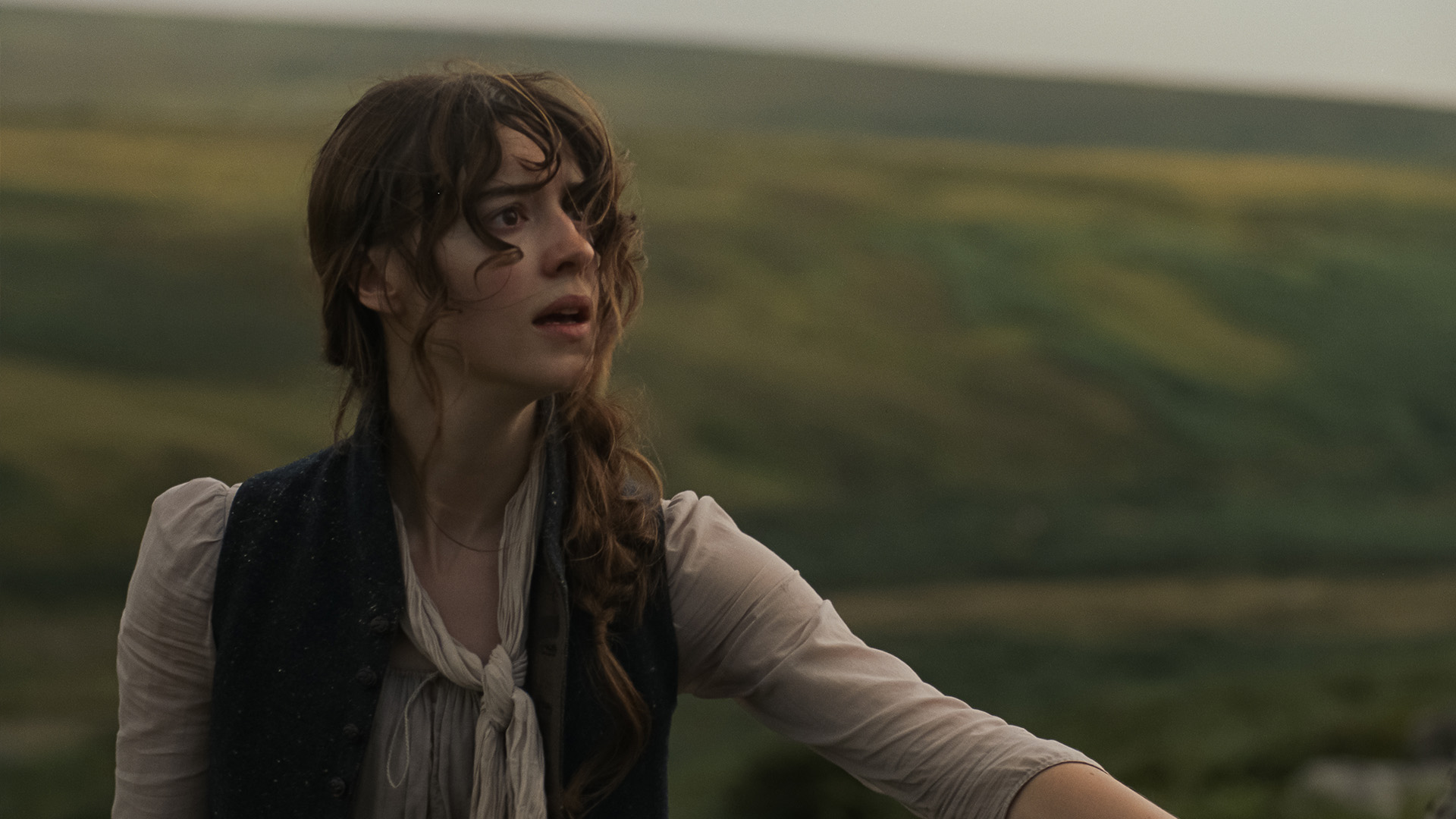
The film’s earthy tones are beautifully brought out on a combination of 35mm film stock and digital. Deep greens and browns in the woods and hills, and a coastal palette of blues and greys. It’s dimmer than we would normally expect of an Austen film; we’re used to something milder and brighter, pretty and pastoral—though Oakley is not the first to make Austen more muted; 2007’s Persuasion is positively gloomy! If there were ever an Austen novel for which to borrow some colouring from the world of the Brontës though, I think Sense and Sensibility is the natural choice. It’s the story that contains the most of Austen’s real life social peril. The Dashwood sisters are actually in the situation that Pride and Prejudice’s Bennet sisters were merely dreading. Their father is dead, they have lost their home and the three girls are all unmarried with little money to protect them. This, in combination with the wildness of a Devon landscape and Marianne’s spirit make the story better suited to this atmosphere than the lower stakes Emma or even the gothic parody Northanger Abbey, where nothing is really as scary as it seems.
The dimmer palette is broken up by periodic flashes of bright colour, like the pink band of Marianne’s dress, or the blackberry juice spilled all over little Margaret, a bumble bee on a blooming purple thistle. Candlelit interiors and afternoon sun-drenched exteriors. It’s a relatively narrow frame. This aspect ratio allows for an intimate view of faces, and for sitting within a landscape rather than gazing upon its vastness (as with Ang Lee’s sweeping widescreen depiction of Devon in 1995). Nature, indeed, serves as the beating heart of the film. The landscape is a part of Marianne. Many gorgeous shots of her lounging amongst reeds, or rushing through woodlands, demonstrate her sensibility, and Oakley’s tendency towards closer shots brings us into it with her. The trees and water are Marianne’s life spirit, they sustain her, but they are her downfall too. A slip in the sea causes her injury (and thus her ill-fated meeting with Mr Willoughby) and a long walk in the pouring rain leads to her sickness.
Costume designer Grace Snell creates a jumbled wardrobe for the Dashwood sisters. There’s a notable absence of any block printed fabrics, but the dresses are still recognisably regency thanks to their waistlines—though a little floatier and more billowing than we would generally associate with the period (for this we will make thematic allowances). The dresses worn in town, and by other ladies in big houses, are more in line with our standard vision of regency, including some delightful evening garments with sparkling silver embellishments.
Marianne is styled with extremely wild hair that reflects her youth and romantic sensibility. At the ball, her dress and hair reflect fashionable and dreamy Grecian influences. Regency fashion was much less conservative than later Victorian styles, with skin-hugging muslin, prints imported from India, and almost no corsetry. As such, there is no need to fear stuffiness in this branch of period dramas.
There is an obvious comparison here to Joe Wright’s Pride & Prejudice (2005). Both adaptations are perhaps slightly more romantic than Jane or her novels ever were, but both have been praised for their exceptional cinematography and design. The costuming in Wright’s Pride & Prejudice is always a point of contention, as the waistlines are much too low to match the regency setting. The film’s most ardent supporters will hail Wright as a genius for setting his film in the late 1700s rather than in 1813, claiming that this was when Austen actually wrote the novel. This is a somewhat misinformed interpretation, as though Austen did write earlier versions of several of her novels long before they were published, First Impressions (Pride and Prejudice’s original title) was a very different novel, written in epistolary form (meaning it was made up of letters, like Lady Susan). It’s also very important to note that in her extensive revisions, Austen took great pains to update her novels and make them more contemporary. In Sense and Sensibility, for example, she updated the cost of the London post in line with current inflation, and inserted references to Sir Walter Scott, a new young poet she felt would match Marianne’s tastes.
A beautiful ball scene is integral to any historical piece. Where Joe Wright famously removes the background dancers from Lizzie and Mr Darcy’s first dance to illustrate the sense of entrancement with one another, Oakley uses my preferred technique of a shallow focus for Elinor and Edward that lets us feel that sensation organically (we see this also in 2020’s Emma., for Emma and Mr Knightley’s pivotal dance).
Sense and Sensibility’s London ball scene is a beautiful wash of creams, whites and pale yellows. It’s packed with people and decorated with white marble statues. Of course, for Marianne, this lovely place is the site of great heartbreak. Creed-Mile’s performance, filled with confusion and denial, is soul crushing. Her voice gets louder and shakier as she starts to make a scene. In the novel Austen writes that ‘her touch seemed painful to him’. Oakley intercuts this with a moving sequence in which Elinor pushes through the crowds to rescue her sister. The moment is so recognisable, transcending time entirely. Right then, Marianne is just a 16-year-old girl who has been cruelly deceived by a boy who she thought liked her. Watching her question herself afterwards, as she started to wonder if she’d imagined their connection to be more than it was, I found myself thinking back to earlier in the film, to the visual inserts of their blossoming romance. Marianne and Willoughby laying in the grass together, her reading poetry aloud, his head on her shoulder, their hands intertwined. It felt like Oakley’s way of screaming ‘No Marianne! You didn’t imagine it! He was paying you special attention!’
A pleasantly surprising highlight is Mrs Jennings, joyfully depicted by the great Fiona Shaw. Her performance is a real tribute to the solidarity and friendship amongst women that was present throughout Jane Austen’s life and work. Caitríona Balfe makes a wonderful Mrs Dashwood, younger than previous depictions, and almost as giddy as her daughters.
The beautiful chemistry between Daisy Edgar Jones and George McKay had me rooting for Elinor and Edward more than ever. Their relationship seesaws continuously between material misunderstandings and innate understandings. An early conversation, staged by a lake at Norland and framed in purple wildflowers, displays the quiet depth of their characters and and the growing strength of their connection. They’re made up of small smiles and jokes, polite conversations and regretful looks, but there’s no mistaking the romance of it.
There’s a delicate balance in telling a story of two heroines, and at times in this film Marianne’s story is at risk of overpowering Elinor’s, by nature of being bolder in its telling. In the end, Oakley’s staging of their individual happy endings rectifies this perfectly. Marianne’s coming together with Colonel Brandon is sweet and understated. A gentle conversation in the woods and an understanding smile. We don’t see them kiss or even confirm their engagement. Elinor, on the other hand, gets to run through the hills to claim her love. This restructuring of the events from the novel (where the entire interaction takes place inside the cottage) makes the moment more thrilling and more classically cinematic. The reversal ties the film perfectly to the title. They are each no longer tied to their restricting roles of ‘sense’ or ‘sensibility’. Most lovely of all though, is the very final moment: one sister squealing in delight for another, bringing us back to the most important thing.