This May, over 130 million people tuned in to watch the visual feast that is the Eurovision Song Contest. Outrageous costumes, questionable choreography and enough flashing lights and lasers to land an aircraft. Eurovision is a multi-million-pound television marvel, designed to push the boundaries of live broadcasting.
But if you were to travel back to where it all began, to the very first Eurovision Song Contest in 1956, you’d hit a brick wall.
There are no official tapes. No master reels. If you search YouTube for the full broadcast, you will find nothing but fan made compilations, static photos and a creeping sense of mystery.
The televised broadcast of the first Eurovision is completely lost to history. Here is the story of how the world’s biggest musical event became a ghost broadcast, the bizarre rules of a forgotten era and the tantalising fragments that have survived the void.
Post-war Europe and the Grand Experiment
To understand why the first Eurovision is lost, you have to understand the world that it was born into. In May 1956, Europe was still physically and psychologically rebuilding from the devastation of World War II. The continent was fractured, and international tensions were still incredibly raw.
Enter the European Broadcasting Union (EBU). Led by Marcel Bezençon, a visionary Swiss media executive. The EBU had been searching for a way to bring these fractured nations together through a shared cultural experience. The Eurovision Network had been made permanent in 1954, after earlier periods of experimentation by sharing TV programmes transnationally in Western Europe. By 1956, the EBU and national broadcasters were actively looking for new and exciting content to be broadcast across the network—perhaps something like a glamourous singing contest…
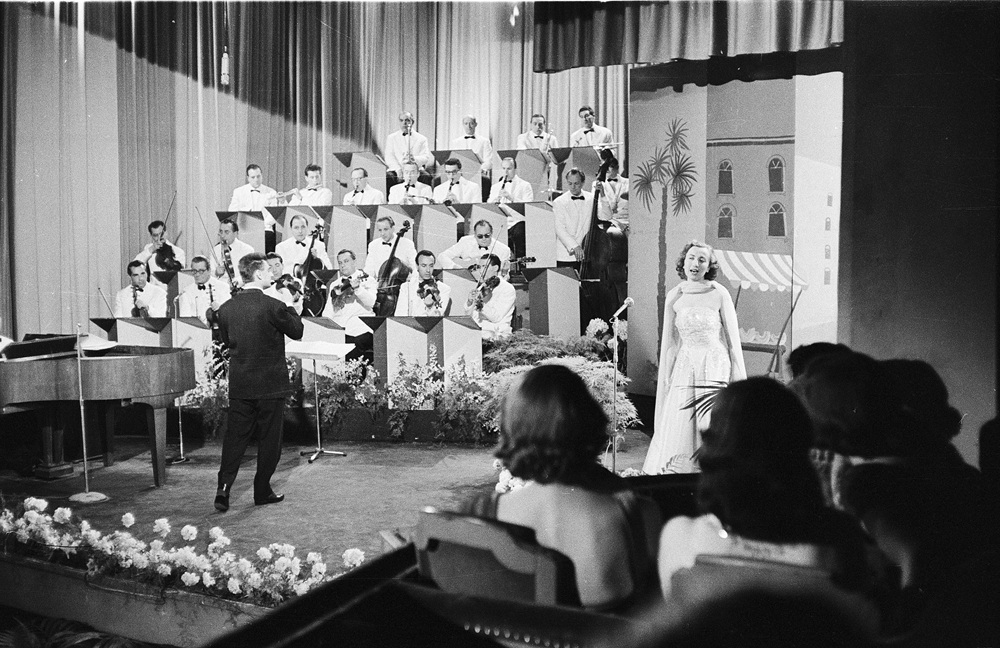
On the evening of 24 May 1956, a fashionable crowd gathered at the Teatro Kursaal in Lugano, Switzerland.
Seven pioneer nations answered the call: Switzerland, West Germany, Italy, France Luxembourg, Belgium and The Netherlands. The staging was an intimate affair, distinctly lacking in wind machines and glitter cannons, built primarily for the dominant medium of the era: radio. Television was the experimental, expensive luxury that only a tiny fraction of the European population actually owned.
The Rigid Rules of Eurovision 1956
If you managed to build a time machine and sit in the audience at the Teatro Kursaal, you would be watching a distinctly different Eurovision from the one we are used to today. The rules of this broadcast were stiff, formal and strictly orchestral.
- Two original songs: Each of the seven competing countries was requested to submit two songs instead of one. Only one artist was allowed on stage, and songs couldn’t be longer than 3 minutes and 30 seconds (the limit is 3 minutes today).
- Ban on movement: performers were strictly forbidden from pacing around the stage or utilising any form of choreography. They had to strand rigidly by the floral arrangement on the stage and focus entirely on their vocal delivery.
- No backing tapes: Each performance was backed by a 24-piece orchestra. If the singer missed their cue there was no digital track to save them.
The music reflected the type of person who might have a TV (well-off, middle to upper-middle class or above) or would attend the live show, which was a distinctly black-tie affair. They would want more ‘respectable’ ballads or traditional chanson-style songs than the pop and rock’n’roll gaining popularity in youth culture. While modern Eurovision embraces high-camp pop, Belgium’s first ever entry was a track called “Messieurs les noyés de la Seine” (The Drowned Gentlemen of the Seine), a melancholy ballad about drowning in a river.
Because television cameras were a novelty, the directors operated with immense caution. There was only one massive camera mounted on a crane, slowly moving across the floor. The event was treated like an elite, private theatre night that just so happened to be transmitted.
And that is exactly why the history of the first Eurovision wasn’t being saved.
How an Archive Vanishes
When modern day Eurovision fans learn that the 1956 contest is missing, they usually assume a tragic studio fire, a flood, or the tapes were simply thrown away. The truth is much more mundane, yet more frustrating. It was never recorded in the first place.
In 1956, live television was treated exactly like theatre or a live radio broadcast. It was an ephemeral event happening strictly in the present tense.
The technology to record a live television broadcast, known as telerecording to us in the UK and Kinescope in other parts of the world, was in its absolute infancy. The process involved literally pointing a specialised 16mm or 35mm film camera at a high-resolution, curved television monitor to capture the glowing electronic image. It was an incredibly expensive process, the film stock was bulky and the visual quality notoriously grainy.
The Swiss host broadcaster, RSI on behalf of SRG SSR, beamed the live signal across Europe via international transmitters. Once the electronic waves left the antennas and hit the few thousand television sets scattered across Europe they vanished forever. Nobody pressed “record” because for the executive of 1956 there was no commercial reason to. Home video didn’t exist and the concept of reruns hadn’t been invented yet. Why waste precious archival space and money on a show that had already aired?
The Secret Vote and the Original Conspiracy Theory
The lack of video evidence has only fueled the flames of Eurovision’s oldest conspiracy theory.
In 1956, the voting system was entirely secret. No scoreboard. Two jurors from each participating country traveled to Lugano to watch the show and cast their votes on paper ballots. However a major logistical issue arose, Luxembourg couldn’t afford to send their own jurors to Switzerland.
In a move that would cause absolute uproar on modern social media, the EBU allowed the host country, Switzerland, to vote on Luxembourg’s behalf.
When the secret ballots were collected, they were counted behind closed doors. The EBU announced Switzerland’s own Lys Assia had won the contest with her bittersweet ballad Refrain.
The big mystery: immediately after the winner was announced, the EBU allegedly ordered all the physical paper ballots to be destroyed. To this day we have absolutely no idea who came in second place, who came last, or if the Swiss jurors used their double voting power to hand themselves the victory.
Without television footage of the jury announcement or a paper trail, the true scoreboard of the first Eurovision is lost forever.
The Fragments that Remained
While the complete 100-minute television broadcast is gone, Eurovision 1956 didn’t vanish into total darkness. Over the decades, music historians, archivists and dedicated fans have cobbled together a “ghost” version of the night using three crucial fragments.
The Full Audio Reel: The saving grace of Eurovision history is that radio archives were meticulously maintained. A complete magnetic audio tape of the entire 1956 radio broadcast, including the announcement, orchestral intros and all 14 songs survived in the Swiss archives. If you want to experience the first Eurovision from start to finish you can close your eyes and listen to it exactly as a radio listener would have.
The Newsreel: While television cameras weren’t recording for preservation, news journalists were inside the venue with their own independent film cameras. A brief, silent newsreel fragment survived, showing a few seconds of the stage setup, the conductor waving his baton and behind the scenes glimpses of the performers chatting in the green room.
The 5-minute encore: The most famous visual artifact belongs to the night’s winner, Lys Assia. As the show prepared to go off air, Vincenzo Vicari, the event photographer hired for the night, managed to capture a brief fragment of Assia taking to the stage for her victory encore.
He took some silent footage on his own cine camera, which was then combined much later on with the radio broadcast recording to give an idea of what the first ESC was like (you can see this combined clip in the Setting the Stage exhibition).
The footage shows how midway through singing Refrain, seemingly overwhelmed by the gravity of the moment, Assia famously forgot the lyrics to her own song. She stopped, laughed, nervously apologised to the audience and asked the orchestra to start over because she was too emotional. For decades those few grainy black and white minutes of Assia’s encore were thought to be the only moving images that survived the night.
Will the lost footage ever be found?
Is there hope that the first Eurovision will ever be fully seen again? It’s unlikely, but within the archive community hope springs eternal.
Every few years, rumours swirl through the Eurovision community of a forgotten telerecording reel sitting in a mislabeled tin in a regional European broadcasting vault. Or perhaps in Italy or Germany, where a local engineer might have attempted to try a crude recording of the incoming signal. After all, lost television treasures turn up in cellars and attics all the time.
Until that miracle discovery happens, the first Eurovision remains a beautiful myth. An event we can hear, read about and picture through the photographs and limited recordings, but never truly see. It stands as a reminder of the days when television was live, temporary and left entirely to the memory of the audience who tuned in that night in Switzerland in 1956.